
Bangladesh-ready starting structure
Begin from a chart that already reflects local trading, VAT and statutory reporting, then adapt it.
Build an account structure around the way your business operates. Clear codes, parent-child relationships and consistent classifications help your team post accurately and understand every balance.
eSolverBooks / Accounting / Chart of accounts
How it works
A practical workflow your team can follow without adding disconnected spreadsheets or repeated data entry.
Choose account categories, codes and reporting levels that fit the way the business operates.
Add posting accounts beneath the correct parent and define their classifications.
Use the accounts consistently across invoices, bills, payments, inventory and journals.
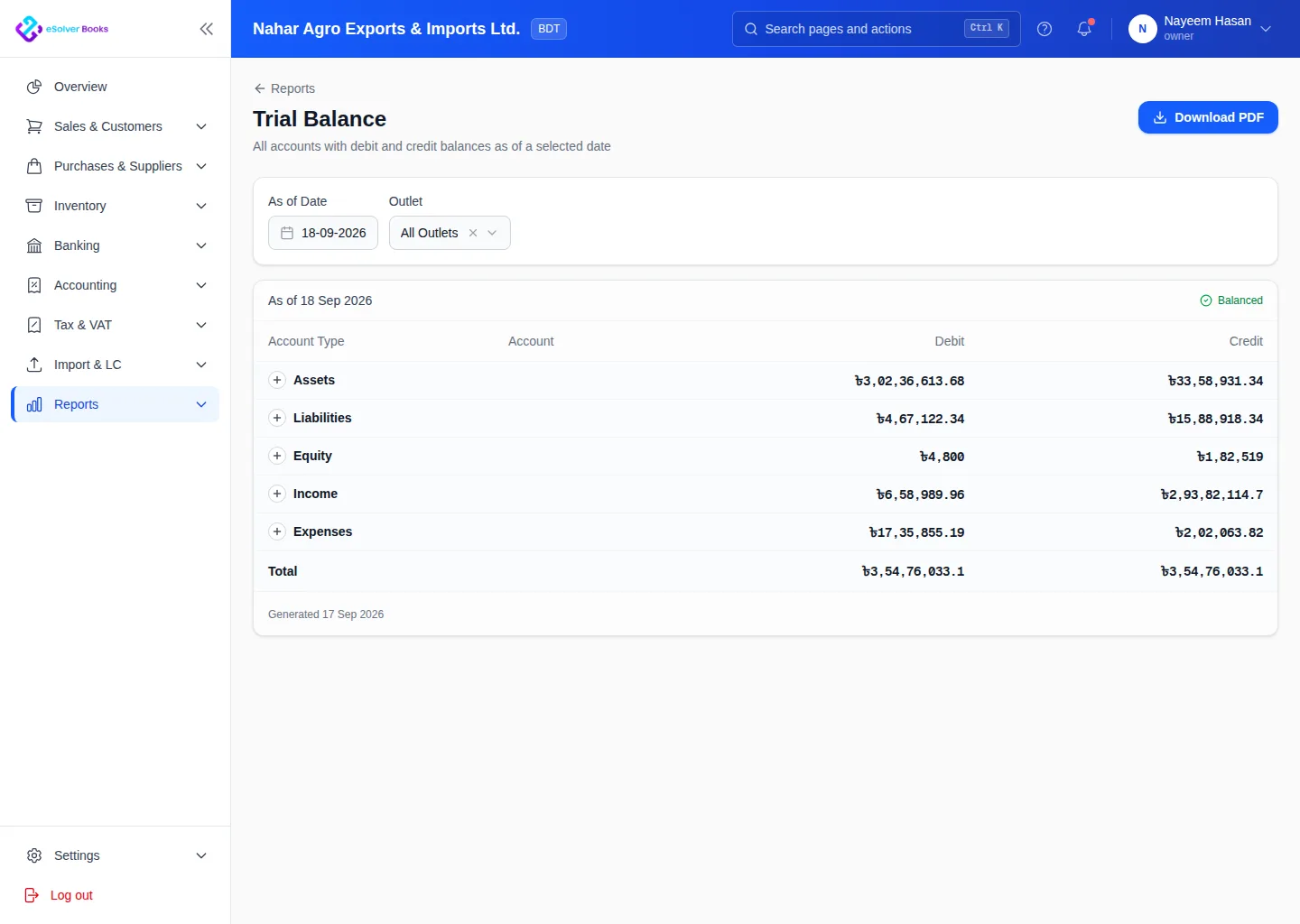
Confirm the trial balance and trace financial statement totals back to account activity.
What you get
A well-designed chart of accounts reduces coding mistakes, speeds up month-end review and keeps financial statements consistent as the business grows.
Begin from a chart that already reflects local trading, VAT and statutory reporting, then adapt it.
Group accounts as deep as the business needs while keeping posting restricted to leaf accounts.
Each account's type decides where it lands in the P&L, balance sheet and cash flow — no manual mapping.
Bring across balances from your existing books with both sides proven before you go live.
Rename, regroup or deactivate accounts without orphaning the history already posted to them.
Click a reported total and land on the transactions that produced it.
Feature details
Understand the main workflow, what belongs inside it and how each capability supports accurate daily work.
Main feature item
Organize resources the business owns or controls.
What it includes
4 connected capabilities designed to keep this part of chart of accounts organized.
Included sub-items
Separate cash, mobile wallets and every bank account for faster reconciliation.
Connect customer balances directly to invoices and receipts.
Classify stock, equipment, vehicles and property correctly.
Record deposits, advances and prepaid costs in the right period.
Main feature item
Keep short- and long-term obligations visible.
What it includes
4 connected capabilities designed to keep this part of chart of accounts organized.
Included sub-items
Connect supplier balances with bills, payments and returns.
Separate collected tax, withholding and filing liabilities.
Monitor principal, interest and repayment schedules.
Recognize payroll, utilities and other costs before the bill arrives.
Main feature item
Explain ownership value and how it changes.
What it includes
4 connected capabilities designed to keep this part of chart of accounts organized.
Included sub-items
Record contributions from owners, partners or shareholders.
Carry accumulated profit and losses forward clearly.
Keep owner withdrawals separate from operating expenses.
Create accounts for legal, valuation or strategic reserves.
Main feature item
Measure income and costs with useful detail.
What it includes
4 connected capabilities designed to keep this part of chart of accounts organized.
Included sub-items
Compare income streams by product, service or channel.
Use contra accounts to understand gross and net sales.
Match direct costs with the revenue they generate.
Separate payroll, overhead, marketing and finance costs.
Create a clearer workflow and give your team information they can understand and trust.
The accounting foundation
Learn what each main category means, how its balance behaves, and when to use its most common sub-accounts.
Main account type
Economic resources your business owns or controls and expects to use for future benefit.
Asset accounts show where business value is held—from money available today to equipment used for years.
Where it appears
Assets appear on the balance sheet. In most cases, a debit increases an asset and a credit decreases it.
Common sub-accounts
Tracks physical cash, petty cash, current accounts, savings, and other immediately available funds.
Examples
Cash in hand · City Bank current account
Records amounts customers owe for goods or services already delivered on credit.
Examples
Customer invoices due · Employee advances
Captures the value of goods held for sale, raw materials, and work that is still in progress.
Examples
Finished goods · Raw materials
Long-term tangible resources used to operate the business rather than purchased for resale.
Examples
Machinery · Vehicles · Office equipment
Main account type
Present financial obligations your business must settle with cash, goods, or services.
Liability accounts clarify who the business owes, why the amount is due, and when it should be settled.
Where it appears
Liabilities appear on the balance sheet. A credit usually increases a liability; a debit reduces it.
Common sub-accounts
Tracks unpaid supplier bills for inventory, services, and other purchases made on credit.
Examples
Vendor bills due · Trade creditors
Holds VAT, withholding tax, payroll tax, and other statutory amounts collected or accrued for payment.
Examples
Output VAT · Withholding tax payable
Records borrowings and credit facilities that must normally be repaid within the next twelve months.
Examples
Bank overdraft · Working-capital loan
Captures loans, leases, or other obligations whose main settlement date is more than one year away.
Examples
Term loan · Finance lease liability
Main account type
The owners’ remaining interest in the business after total liabilities are deducted from total assets.
Equity accounts explain how much owners invested, how much profit the company retained, and what was withdrawn.
Where it appears
Equity is reported on the balance sheet. Credits generally increase equity, while drawings and distributions reduce it.
Common sub-accounts
Records cash, assets, or other value contributed to the business by owners, partners, or shareholders.
Examples
Share capital · Partner contribution
Represents cumulative profit kept in the business after losses, dividends, and prior distributions.
Examples
Opening retained profit · Current earnings
Separates portions of equity for legal, strategic, or valuation purposes without creating an outside liability.
Examples
Legal reserve · Revaluation reserve
Tracks money or assets owners take from the business for personal use, reducing their equity interest.
Examples
Owner withdrawal · Partner drawings
Main account type
Income earned by delivering products, services, or other value during an accounting period.
Revenue accounts separate income streams so you can see what customers buy and which activities drive growth.
Where it appears
Revenue appears on the income statement. Credits increase ordinary revenue; contra-revenue accounts reduce it.
Common sub-accounts
Records income from selling physical goods, merchandise, manufactured products, or inventory.
Examples
Retail sales · Wholesale sales
Captures fees earned from professional work, subscriptions, maintenance, consulting, or labor.
Examples
Consulting fees · Support income
Tracks earnings outside the business’s primary operations to keep core performance easy to evaluate.
Examples
Interest income · Rental income
A contra-revenue account that records refunded goods, allowances, and discounts against gross sales.
Examples
Returns & allowances · Sales discount
Main account type
Costs and resources consumed while generating revenue and operating the business.
Expense accounts make spending visible by purpose, helping teams control costs and measure profitability accurately.
Where it appears
Expenses appear on the income statement. A debit usually increases an expense and reduces net profit.
Common sub-accounts
Captures the direct cost of products or services sold, allowing gross profit to be measured correctly.
Examples
Material cost · Direct labor · Freight-in
Records employee compensation and related employer costs for the relevant team or accounting period.
Examples
Salaries · Bonuses · Employer benefits
Tracks recurring overhead required to keep daily business operations and administration running.
Examples
Rent · Utilities · Marketing
Separates the cost of borrowing and financial facilities from normal operating expenses.
Examples
Loan interest · Bank charges